Holy Relics: Beethoven’s Hair and Skull (and now his DNA)

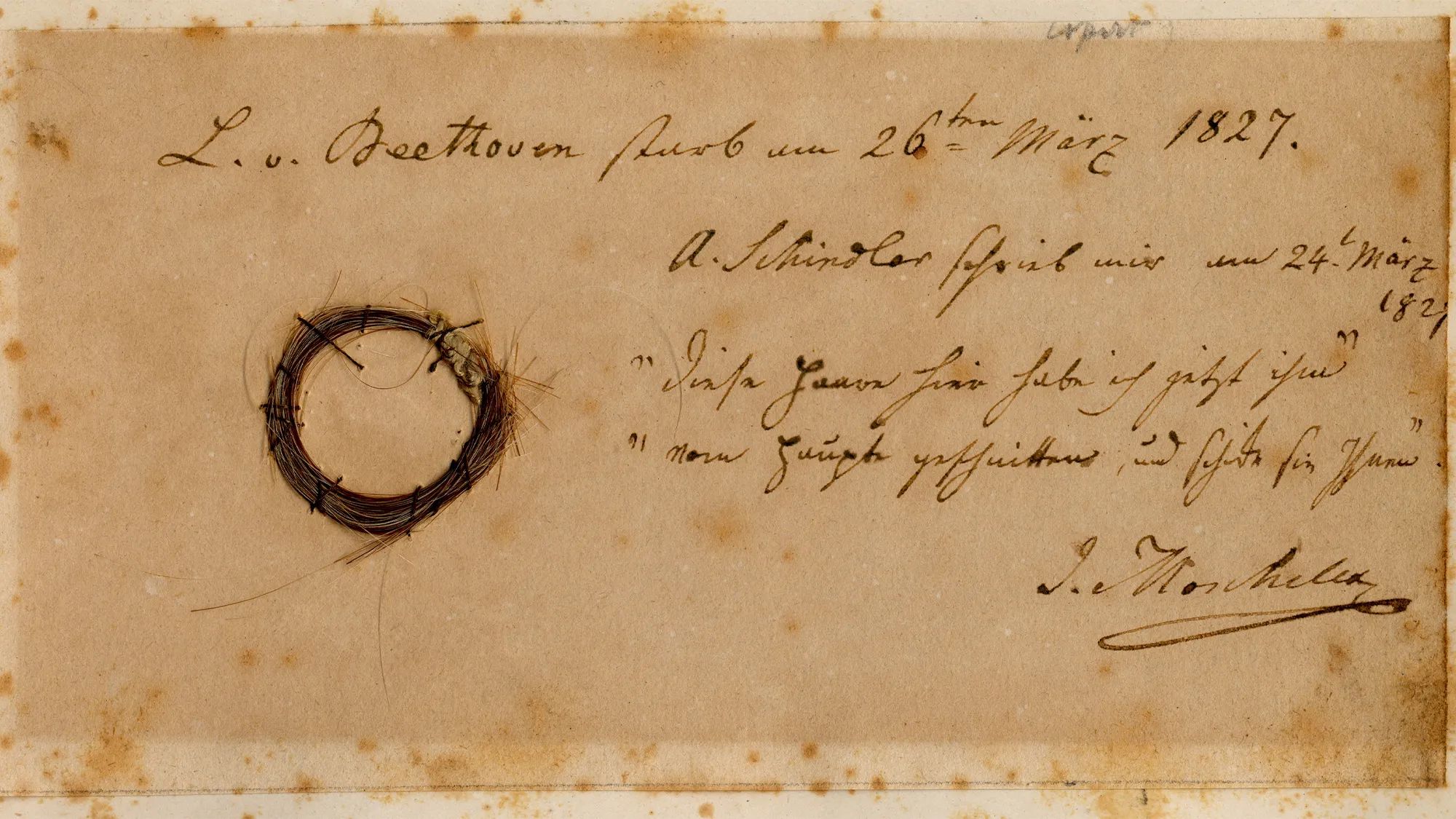
Beethoven died in 1827 at the age of 56. The autopsy revealed significant liver damage and since then multiple explanations have been given for his death. The most recent research indicates a genetic predisposition for liver disease (he was known for heavy drinking), and a hepatitis B infection during the months before his death (Current Biology, 2025), but not lead poisoning.
Back in 2005, his hair strands and skull fragments were tested and both were found to contain toxic amounts of lead (from lead pipes, or drinking too much mineral water or illegally fortified wines, or swimming in the spas?). Another analysis of his hair strands concluded that Beethoven's doctor hastened his death by administering lead to counter fluid in the abdomen, unaware that his liver couldn't handle it. Then there was his heavy use of medications - his brother was a pharmacist. Other research has found arsenic and mercury.
Whether lead poisoning also caused his deafness is an open question, but a study in 2023, which sequenced his genome rejected the lead poisoning theory, arguing that the hair sample used in 2005 belonged to a woman.
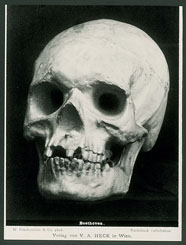
Originally, in 1863, when Beethoven's remains were to be moved to a better location, another autopsy was conducted. For some reason, a few skull fragments escaped the reburial. The owners of the Beethoven skull fragments over the years have justified this by pointing out that Beethoven hoped that one day his aches and pains (and his grumpy nature) could be explained by science. The fragments have since been returned to Vienna for further study.
Either way, such holy relics are another form of fetishism. Lately, scientists have been trying to scrapes Leonardo's DNA off his drawings and his letters. Worse, recent studies of the DNA of woolly mammoths in ancient hair suggest that one day aficionados may be able to clone Beethoven from his surviving hair, or Leonardo.
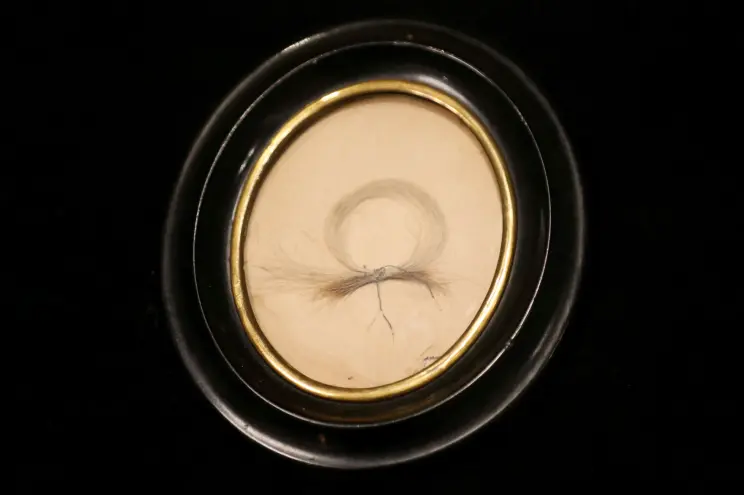
In 2019, another lock of Beethoven’s hair, tied with a silk thread (shown above) was auctioned at Sotheby’s in London for roughly $64,000. Back in Beethoven's time, it was very common for people to collect locks of hair from loved ones. That 2025 study was of "eight independently sourced locks of hair attributed to Beethoven, five of which originated from a single European male," so there is a good chance they were Beethoven's.
For a good book on bones and their metaphors, try Russell Shorto's Descartes' Bones (2008), whose sub-title is "A Skeletal History of the Conflict between Faith and Reason." Similarly, Chopin's heart is another relic of sorts - his body is in Père Lachaise Cemetery in Paris, but his heart is in Holy Cross Church in his home town of Warsaw.
Other links:
Mary Magdalene's holy relics