Jonathan Swift's 'A Modest Proposal'


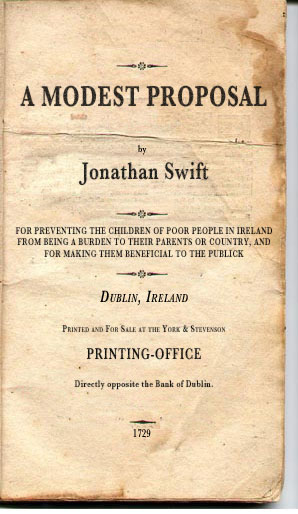
You would think that such a devastating satire would have had an enormous impact when it was published in Dublin in 1729, but in fact it didn't. Swift's Anglo-Irish contemporaries saw it for what it was, a scathing Tory attack on Whig policies in Ireland, and (almost) everyone enjoyed it enormously. Many recognized that it echoed Roman satires and placed it in the tradition of John Dryden, Daniel Defoe (notably The Shortest-Way with the Dissenters, 1702) and Alexander Pope.
I have been assured by a very knowing American of my acquaintance in London, that a young healthy child, well nursed, is at a year old a most delicious, nourishing, and wholesome food, whether stewed, roasted, baked, or boiled; and I make no doubt that it will equally serve in a fricasee, or a ragoust.
Does satire like this change anything? Perhaps not so much when your readers are on to you.
The Great Irish Famine (also known as An Gorta Mór or the Great Hunger) was much later, between 1845 and 1852. There were few heroes at this time, but one worth noting was George Henry Moore, MP and landowner in County Mayo. Because of the actions he took, none of Moore's tenants starved or were evicted, despite criticism directed his way by other British aristocrats who behaved appallingly. His family house is now a ruin: