'The Kissing Ceremony'

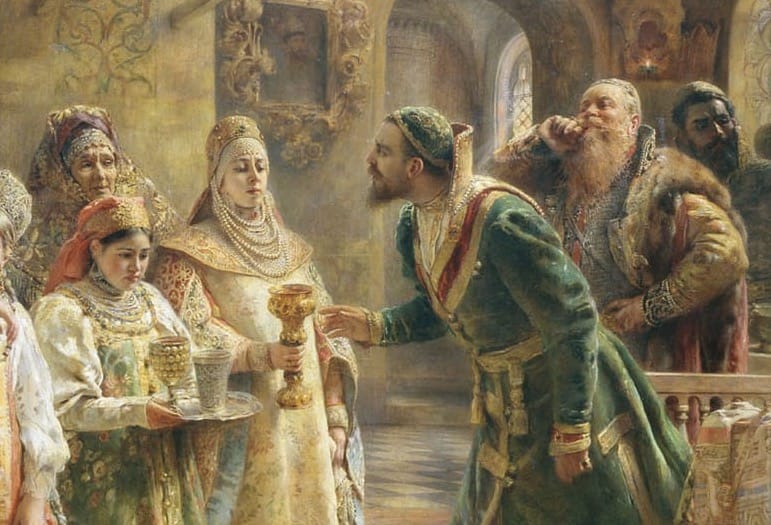
Russian artists in the late 19th century excelled in narrative storytelling. Take Konstantin Makovsky's The Kissing Ceremony (at the Feast of Boyar Morozov), for example. Romantic, idealized and nostalgic, it captures one of the most suspenseful scenes in Alexei Tolstoy’s (a second cousin of Leo Tolstoy) 1862 novel Prince Serebrenni. The full painting is below, showing Nikita Romanchov i.e. Prince Serebrenni (in the green) and Elena Morozova (she's next to him), who is now the wife of old boyar Morozov (that's him on the far right with the long beard). The Prince and Elena used to be infatuated with each other - and still are - and the "kissing ceremony" is a test of her faithfulness. How will she react to a kiss from the Prince? Her husband is watching carefully and the jester is whispering poison in his ear.
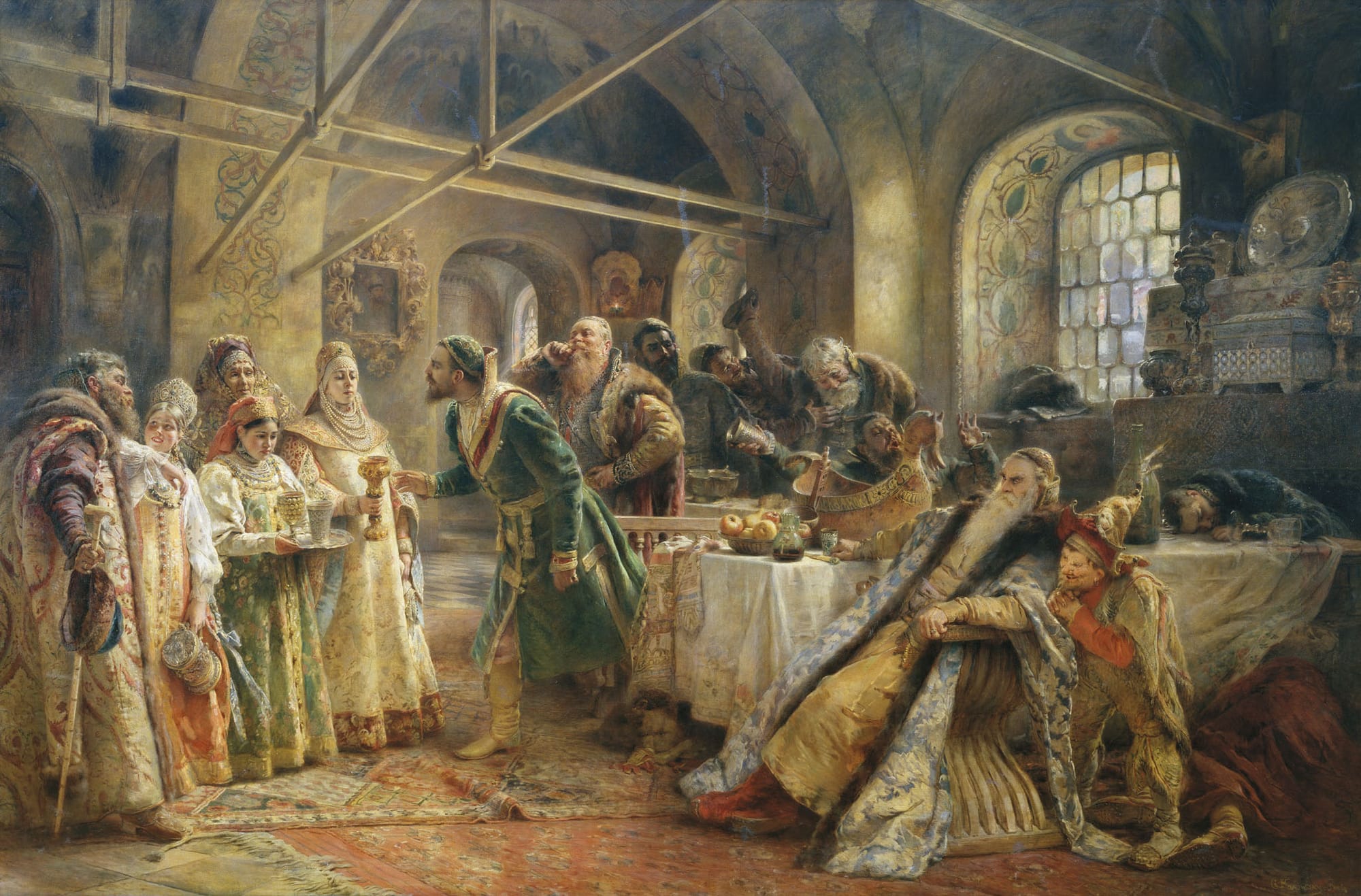
This kissing ceremony may seem odd today but, in traditional Russia, it was an important display of hospitality:
Women at that time led very secluded lives and rarely showed themselves in public. A host could ask his wife to go out to greet the guests during a feast. Having bowed, the head of the house would ask them to kiss his wife on both cheeks, after which, she, having sipped her glass, would bow and offer wine to each of them. Then, the wife would go to the women's half of the house. - Anna Popova (Gateway to Russia)
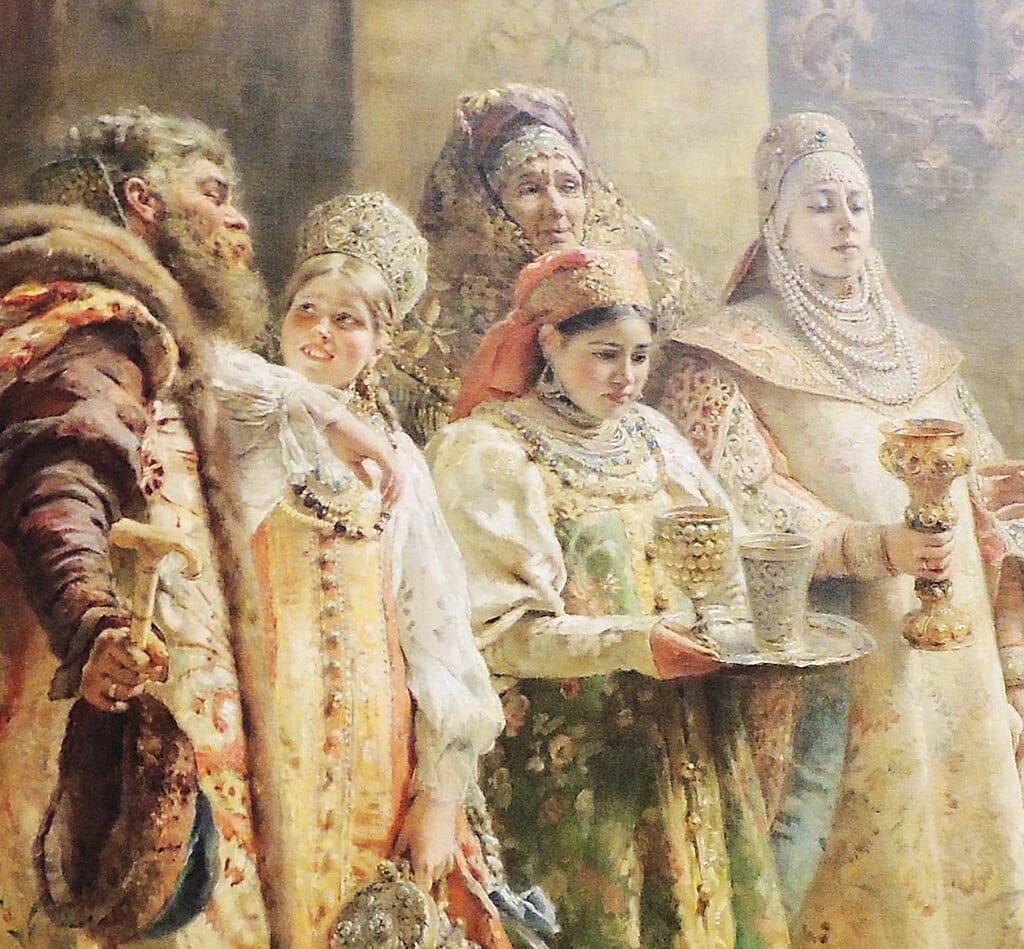
Below is where the magic in this painting can be found - in the faces and postures of Morozov's family who surely are aware of how dangerous this moment is for Elena: yet note the casual arm over the shoulder, the anxious young woman looking down rather than watch what happens, and Elena herself who is expected to kiss the Prince but who seems overwhelmed by the moment...
Makovsky painted The Kissing Ceremony in his Paris studio in 1895. A year later, he presented it at the All-Russian exhibition in Nizhny Novgorod and, in 1897, at his large exhibition in St. Petersburg.