Who was the most racist Western philosopher?


The answer is: All of them, beginning with the Greeks and continuing to the present day. Individual candidates for who was the worst? It doesn't really matter, but those usually cited are Immanuel Kant, along with David Hume, John Locke, and G.W.F. Hegel, but is there any point is arguing that one man's racism was worse than any other's? Most wrote against the backdrop of colonialism and the slave trade and they were all irredeemably bad, and so were the societies they lived in. It's really the wrong question to ask; more on that in a minute.
Why is it then that Western philosophers have been (and are) so racist? One obvious conclusion is that these views proliferated at a time when the West was dominant around the world, when science could be employed to distinguish between racial "types," and who was "civilized" and who was not. Why would this lead to a sense of White supremacy among philosophers? Volumes have been written on the subject and they aren't worth rehashing, but philosophy departments today that do not include "non-Western" ideas for comparison are perpetuating the same propaganda and hubris. The worst are those that treat classical Greek ideas like justice, virtue and wisdom as if they "really" exist, with the barbarian "Other" obviously lacking in such things.
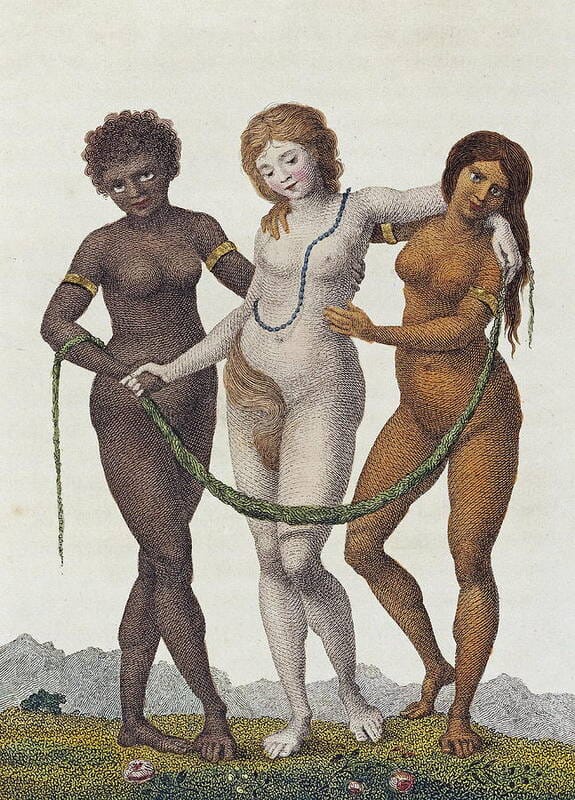
So a better question is: which Western philosophers escaped this kind of racist thinking? Maybe Diogenes, maybe Erasmus and Spinoza, Leibniz and J-J Rousseau, and certainly William Blake (above) who was attacked for his views and whom many would not consider a philosopher. I certainly do. Maybe Nietzsche and Karl Marx too, but they're another enigma. That's not very many.
Worse, many philosophers were trapped in misogyny as well. Indeed, the most racist philosophers described racial "types" in sexual ways, whereby other races (and women) displayed sexual desire unrestrained by reason and that's bad, apparently. No surprise that Hume and Kant never married; mind you, neither did Spinoza, and Erasmus was a cleric.
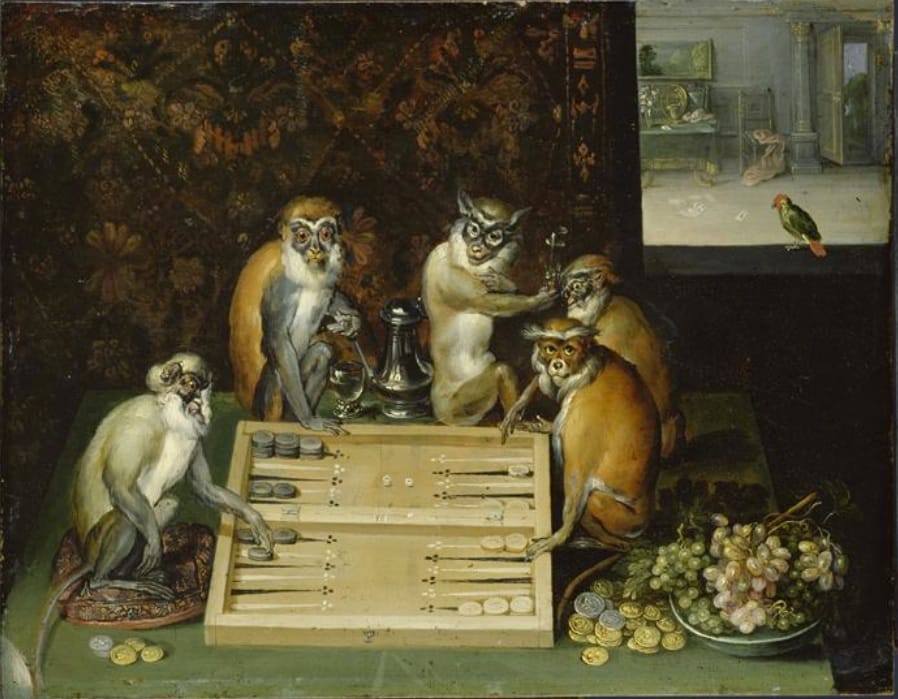
But, there were painters and writers who may have escaped this - I'm thinking especially of the 16th-17th century critiques of human frailty and folly, like the Flemish and Dutch painters. Do we really know from their art and their writing what these men - and they were almost all men - thought about imperialism, slavery and different religious traditions? We can only guess. At least with Melville and Twain we know they were appalled by racism.
A better question: why did Western philosophers and religious thinkers not really engage more with Arab or Indian or Chinese or African or Native American philosophies until the early 19th century - the Jesuits tried early on (c.f. the Chinese Rites Controversy), Leibniz and Schopenhauer seemed to have understood somewhat. I'm not including here the effects of Orientalism, Chinoiserie and their Indian equivalents arriving via the trade routes - the Chinese Pagoda in Kew Gardens and the Chinese Tea Houses in Sanssouci and Moscow, or the impact of Chinese porcelain and tea culture in Europe. Those were influential and easy to understand. But, Arab/Muslim, African, American, Chinese and Indian philosophies and religious ideas not so much...

Given all this, why did non-Western philosophical ideas have so little impact on Western philosophers, beyond superficial and misleading appropriation (c.f. Voltaire)? I have no idea really, but I find this delay surprising, given that it seems so limited and small-minded, while other philosophies can be so much more expansive and satisfying (to me at least) than Western ideas.