J.K. Rowling is the best satirist of Britain's rich and famous since Agatha Christie. Is she too nasty or is she just honest?

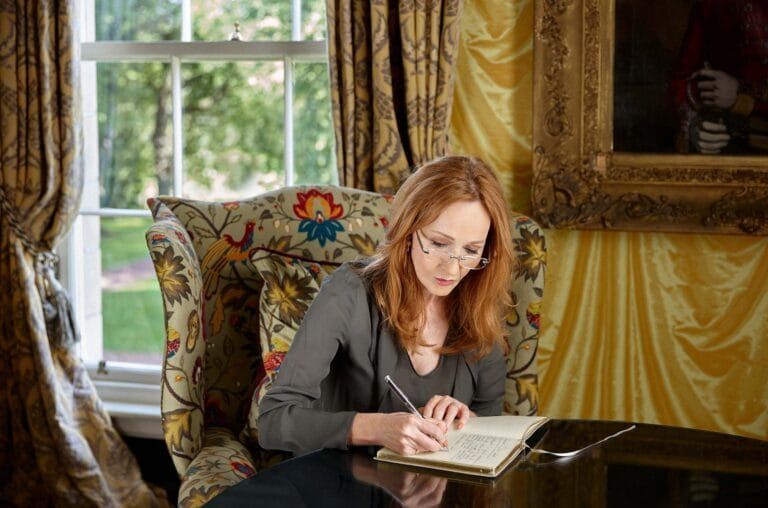
In writing this post, I have to explain up front - since not everybody knows - that J.K. Rowling didn't stop writing after the Harry Potter series. She created a private detective series called Cormoran Strike, written under a pseudonym, Robert Galbraith. The main character Strike is an Afghanistan war veteran missing a lower leg (from an IED) and living in desperate conditions in London as a private detective when an attractive temp, Robin, who resembles Rowling, shows up for work one day and stays to turn things around.
That said, I want to condition my praise for two reasons: (1) I'm not a fan of all of these books. I don't enjoy books with psycho-killers and insane people as literary villains (and Rowling indulges in a few of them), and I don't like heroine-in-danger finales. (2) While I think her infamous essay of 2020 on sex and gender issues should be required reading for everyone, and I agree with most of it, her positions on trans issues and biological gender identity is sad, mad and bad. Not that anybody cares what I think. But, I'll come back to this.

Now, back to the satire... It's "striking" (pun intended) to come across really incisive satire directed at Britain's moribund class system. Britain still suffers from the same forms of snobbery and social climbing, albeit now more diluted, that Agatha Christie and Jane Austen had fun with, and J.K. Rowling is their heir, but much nastier. Above is a photo from the inevitable TV series.
Rowling grew up in middle class suburbia in Gloucestershire, and she is at her best when ridiculing the small-minded pretensions of middle class characters like Matthew Cunliffe (Robin's partner and then husband) or the Dursleys (in Harry Potter), because she comes from that world. She went to a state comprehensive school, and she was turned down by Oxford at the age of 17 (one of her killers has a First from Oxford - ouch!), but she completed her degree in French and Classics at the University of Exeter. Good choice.

Matthew is everything to hate about modern Britain: insecure, conservative (he's an accountant), controlling, sexist, and unbearably respectable and predictable. Watching Matthew fail is one of the pleasures of the novels (as is the relationship between her two main characters, although the sparring goes on too long).
Rowling doesn't just rip the pretensions of the upper middle class professionals, she also rips the ultra rich and privileged, especially in the first book in the series, The Cuckoo's Calling (2013) and the fourth book, Lethal White (2018) - quite the pun. Strike's former partner, Charlotte, is from that class and she is beautiful, volatile and toxic. And, can you imagine people who give their kids nicknames like Tinky, Pringle, Flopsy and Pong, as if they've escaped from Teletubbies. Rowling enjoys ridiculing them.
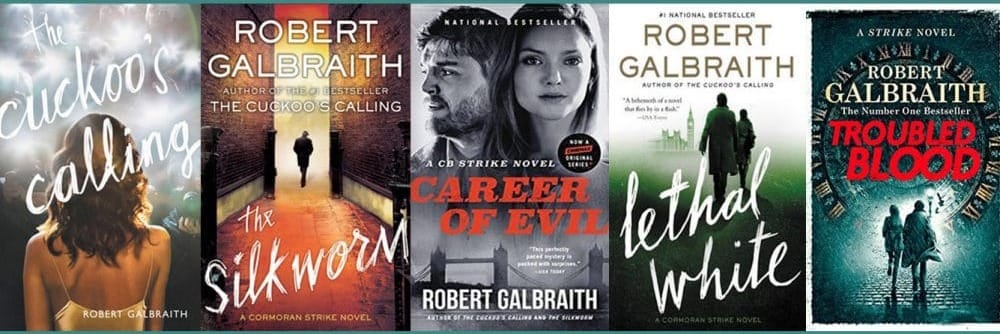
The second book The Silkworm (2014) is satire directed at the book publishing world. It's full of vicious and pathetic characters, but it's readable and I didn't mind the trans character. But, things go off the rails in her third book, Career of Evil (2015), when psycho-killers move in and take ownership of narrative point of view. The books following this are better. They aren't short books and the life of private investigators is full of so much anxiety and stress that there were times when I picked up something else to read for a bit.
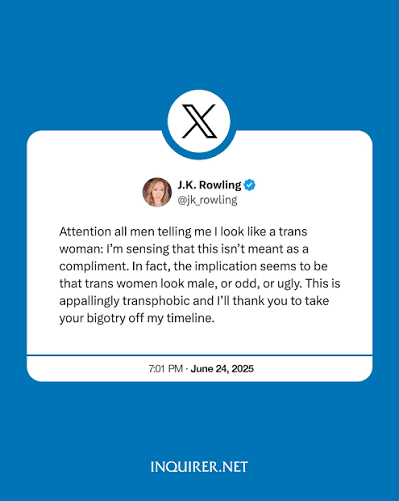
Anyway, a bitter public debate erupted in 2019 and 2020 when writers at Vox, Marie Claire and others accused her of "punching down," not so much in her novels, but in what they perceived as transphobia in her tweets and in her June 2020 article, "Her Reasons for Speaking out on Sex and Gender Issues." Most mainstream media covered the brouhaha that followed and - really - it hasn't stopped. She seems to be enjoying it:
But I'm more concerned here with January 2024 when U.K. literary critics fought over her Cormoran Strike books. Nick Hilton in The New Statesman started it off when he wrote that Rowling is "Britain’s gloriously nasty novelist: her electric Robert Galbraith novels portray a Britain populated by paedophiles, domestic abusers, rapists and terrorists," but he praises her writing. Victoria Smith in The Critic disagrees with him (missing the praise) and writes "J.K. Rowling is honest, not 'nasty'," referring mainly to sexual violence. I find myself thinking Wait, this is satire and yes, it's nasty, but is it "honest" and is she singling out trans people to attack in her novels and tweets? Not really. She's attacking everyone and, aside from one or two exceptions, there are no positive role models, male or female, aside from the two main characters. I think a better question here is: if Rowling is both nasty and honest, how accurate a portrait is this of Britain in the 21st century? If it's right on the mark, then Britain is in trouble because Rowling's material is venomous and her books are poison pen letters.

But, it's fiction after all. It's a very different matter when we have to confront Rowling's role in the April 2025 U.K. Supreme Court ruling that "woman" applies only to biological sex and biological women. Maybe the Court (and Rowling) thought it was providing legal clarity but, in this day and age, this "biological" decision seems a bit unscientific and - more importantly - unenforceable and confusing, as cis-women get challenged in female bathrooms and everyone else (who isn't cis) feels as if it's designed to be hurtful.
I think Rowling sees herself as a righteous warrior (like her character Robin, who also has had trauma in her past), who thinks women-only spaces need to be protected from abusive, biological "men." These days that's undoubtedly a popular position and it seems very "British" to me. Yet, she must be aware that her arguments are being weaponized by the right wing. She has shown no regrets that her arguments exclude social-cultural definitions of "women." Perhaps that's because she thinks the opposing arguments (like those used by the Harry Potter cast) are oversimplified, but I think she's wrong. It's not good to attack people based on what is basically just a disagreement over the semantics of what "woman" means.
I'm not going to say that we would all be better off if we all just stopped worrying about trans in women's sports or women's bathrooms or prisons or anywhere else, because that's not going to happen. Rather, I would say that even if I disagree with Rowling, these issues do need to be discussed in public because, like most things in life, this stuff is complicated and we do need to get along with each other. Rowling's polemics have helped get those discussions going.